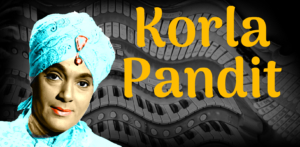
And so it begins: Korla followed Landsberg’s instructions and became an overnight star as one of the pioneering celebrities of early television. At the time, there were only 2 stations available in Los Angeles, and maybe 10-15,000 sets being watched.
Korla’s gentle and shining eyes had a devastating effect on the female (and sometimes the male) viewers! One fan later described Korla as being “Michael-Jackson-famous”; meaning that virtually everyone knew who he was. In those days, television was live, and many people did not yet own a set: Writers report dozens of Los Angelenos hovering on the cold sidewalk outside the window of a TV retail store, watching and listening to Korla’s mysterious show in silence – sometimes afterward remaining there almost in a trance!
Korla stated that there was a staff of 13 or 15 people on the evening show crew, quite a big setup. Often, his original Korla Pandit’s Musical Adventures show ran from 6:15-6:30, followed immediately by his contracted job supporting the Time For Beany children’s show. (He worked for 2.5 years as musical director of Beany, which won several early Emmy Awards.) In April 1949, there is announcement of a second nighttime Korla KTLA show on Wednesday evenings called Musical Journey. (It’s somewhat hard to keep track of the shifting names of his shows, which are all quite similar…)
26min!
Notably, this is the first all-music show ever on television. For that alone, it should go down in history. But the quality and impact of what he did makes it greater than just the musical content. Certainly, we can imagine a rather dull music show that could have taken that title, but this show was already quite different…
A serious off-screen announcer began and ended each program. The opening shot was an out-of-focus close-up on the jewel in Korla’s turban. The shot pulled into focus and they gradually pulled back to reveal the man himself, playing the traditional musical opening, Magnetic Theme. Audiences heard his classic Indian-sounding music with rhythm, drone pulses, and exotic-sounding melodies. Most of these were indeed Korla’s originals, although some (like Song Of India) were based on extant classical compositions. Despite the Indian/Middle-Eastern look of the show, Korla played a variety of music: There were old standards (which he would have been playing since childhood), Latin instrumentals, ballads, and general 1950s schmaltz. He always added his own exotic-sounding compositions, often played over a drone and some kind of percussive pattern he’d create. His skills and touch were quite evident – the musicianship is exceptional and always quite musical. While some advanced musicians explored the outer ranges of jazz and harmony, one of the greatest compliments to Korla was that “he never lost the melody.” This music was weird and cool – but really quite accessible to 1950s America.
He also developed techniques and ideas on the Hammond that are still impressive today. In the hands of other players, the Hammond organ always sounded like “an organ,” very sustained and smooth. By slapping the keys with flat palms and stomping the bass pedals with his feet, Korla played beats, generating a rather convincing tribal hand-drum sound. He simulated music boxes, marimbas, vibes, and church bells (before Hammond created their own “Percussion” setting.)
He would also play both keyboards (the upper and lower “manuals” of the organ) with one hand simultaneously. Not to mention another trademark gimmick, which was revolutionary at the time – moving from piano to organ, or both, while playing live. (In later years of ‘70s progressive rock, having a “stack” of different keyboards gave Rick Wakeman and Keith Emerson their orchestral palette of tones, but really this was all an extension of pipe organ layering of tones.)
Rarely seen, sometimes he even added a celeste (a bell-like mechanical keyboard) or a Hammond Novachord organ: The Novachord is actually an earlier organ design, but capable of very exotic and shimmering tones. Such a sound-creation instrument was perfect for Korla, and he was using it on his original KTLA shows, but no known recordings of him with the Novachord still exist.
On Sunday afternoons, KTLA then added a Korla music show that was actually expected to fail: There wasn’t yet any daytime TV before 4pm on the weekends, usually just a station’s title card as a static placeholder. Korla claimed that they’d predicted to him and others, “watch this turkey die.” And there was only one man besides Korla on the set running a camera – compared to the dozen staff members attending to his popular evening show. But with Korla’s magic music, the Sunday show took off unexpectedly, and was an instant hit as the #1 (since there was nothing else on to watch!) but this was a hit nonetheless. Soon it was expanded to 2 hours, and Korla was saturated all over the Los Angeles television week. The audiences loved it and more and more attention is coming his way.
In March 1951, Downbeat music magazine mentions this #1 show and explains the beautiful blonde – who helps him with the mountains of fan mail and gifts – is his wife. Several times, they said he used to be called Juano Rolando… Yet another name!
It’s amazing to realize that Korla made over 900 of these televised KTLA shows, all while gazing alluringly into the camera. As one writer put it beautifully, “it was television seduction at its finest, for it was latent, rather than blatant.” Such an innocent time, at least in public eyes, for sexuality, culture, and music. (Consider the era; his musical palette is pre-Elvis and pre-Buddy Holly; a time when rock and roll literally did not exist yet…)
Not to mention – the show’s musical qualities were superb. Ignoring the obvious visual gimmicks, he was simply a masterful musician with a great range of musical styles. He moved from slow popular melodies to Latin beats and trippy Indian/Middle-Eastern styles that seemed so remote and cool for the time. The exotic and familiar, brought to every home with world-class musicianship and ideas. His music beamed via antenna into the rather small black and white screens of the day – the only sizes available, 7-to-10 inches. These families were having their first (and certainly very memorable) views of the television form. Only a few of these early KTLA television shows were recorded via 16 mm film as the “kinescope” process – and these appear to have been lost. Most of his shows were just beamed live to the airwaves, never recorded and never to be seen again.
However, some of the shows were filmed, and (without Korla’s knowledge or consent) they were sold to other stations around the country. Only in receiving fan mail from other states did he realize that the other shows were “out there.” This became a point of conflict between him and Landsberg – one of several that cropped up.
