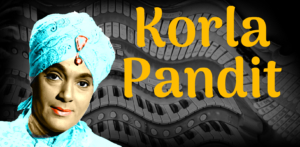
In many ways, his big breakthrough was the work between June 28, 1948, and January 28, 1949, just seven months when he was brought in as musical director and performer for a major national radio broadcast, called Chandu – The Magician.
This was a revival of a mysterious magician character called Chandu from the 1930s. The Chandu story had been created to play into American audiences’ recent fascination with Eastern culture and mysticism, not long after the 1922 discovery of King Tut’s tomb. The 1930s version was a radio show and was a film lead played by Bela Lugosi. In the story, “Frank Chandler” was an American white man who went to study the mystical arts in India: Frank Chandler retuns wearing a turban, and with his name changed to “Chandu”. Chandu used his new magical powers to fight evil…
(A turban, new middle-Eastern name, a move from India to America… sounds familiar?)
In 1949, Chandu was a syndicated daily show, sold and played in many areas around the country when radio was big; every household had a radio. It was the biggest national impact available in the days before television caught on. The Chandu radio program was broadcast live 5 evenings a week on the Mutual Don Lee Network. As musical accompanist on the show, Juan Rolando played Indian-sounding background music and sound effects on the Hammond electric organ to set the scene. When the credits were run, they announced a new persona as “Musical accompaniment by Korla Pandit” to tie in with the theme of the show: But the actors still knew him as Juan Rolando, local Union Musician. Korla Pandit was a new character name invented just for the show. Whoever conceived the name, it was suitable, because “Pandit” is a title used for someone who is a master or expert, and often used for someone who has mastered music.
One of his Chandu show friends was the character actress Irene Tedrow (who later played Mrs. Elkins on Dennis the Menace). Even though Chandu was a radio show, Irene always dressed in Egyptian garb for rehearsals and the radio shows, as it helped her embody a character… an interesting concept.
At this time, Beryl and John/Juan/Korla decide he should really embrace this successful new persona from the big national show: He changed his professional and public persona to Korla Pandit from that point onward. Just as many Hollywood stars changed their names and created a look/image (Marilyn Monroe, Cary Grant, Judy Garland, John Wayne, Rock Hudson, Kirk Douglas, etc.) one can create and then inhabit a fairly “larger than life” character.
Beryl helped him form the look and presentation. As with those other Hollywood stars, Korla Pandit becomes his identity for the rest of his life. The turban is interesting, but an obvious choice; it’s a hallmark look, always noticed, although he could have appeared as an Indian man without wearing one. The turban is more common in the Sikh tradition, but it’s likely they didn’t know much about actual traditions, and were seeking a look that was obvious and easy-to-understand. The jewel (Sarpech) in the center is traditionally a sign of a high-status or royal person.
We need some perspective on their choice for him to present as “Indian”: For most Americans at the time, cultural awareness of the Asian continent was low. There were characters in books and film, some magicians playing with the concept – but very little reality and presence of true Indian culture here. It had been illegal for people from India to immigrate into the United States since 1917, a racist law simply designed to keep Asians out. By 1946, only 100 persons per year were allowed to immigrate from India to the USA, so there was a significant limit of exposure to any true Indian culture in the states.
However, those presenting from “the exotic East” had more cache and intrigue often because of this lack of awareness. Indian performers who were singer, dancers, or musicians seemed to have than struggling black entertainers more obviously descended from the slave trade. So “passing” as Indian was significant to his possible levels of success, taking him from a situation of unfortunate disdain to the full opposite, a position of admiration. As an “Indian entertainer” Korla was not only admitted through the front door – he was welcomed and celebrated as outstanding and special. But in those days, even successful and admired black artists had to deal with terrible laws and prejudice. Soon after, John Redd officially registered himself for his Social Security card under his new formal name; Korla Pandit.
On August 5, 1948, Beryl and Korla’s first son was born: They named him Shari Pandit.
November 26, 1949; John Redd is still appearing on on Armed Forces Radio – but now billed as Korla Pandit, and no longer as Juan Rolando. Did anyone working there or in the audience take notice of the same musician and presentation, but with a different name? As with L.A.’s black nightclubs (who had known John Redd and saw him later appear as Juan or Korla in some other venue) most people understood the change and seemingly “let it slide”: He was succeeding, and most people were pleased and proud of his accomplishments despite the surrounding social impediments.
Host Tom Breneman had a huge hit radio show broadcast live from his Hollywood restaurant. The show was “Breakfast at Breneman’s” and it reached over 10 million people each week! Already a hit from the Chandu show – this new guy Korla Pandit became a frequent and celebrated guest on Breneman’s show, as were major stars of that era. It was more wonderful exposure for the young man.
In 1948, Korla was playing for a fashion show at the restaurant when he and Beryl met television pioneer Klaus Landsberg. Klaus loved Korla’s exotic presentation, and so offered him his own 15-minute daily television show on the new local Los Angeles station KTLA. KLTA/Channel 5 was the first major station on the West Coast, and these are indeed very innocent days of the television phenomenon. Shrewdly, the job was offered with the stipulation that Korla would also provide musical accompaniment for another children’s televised puppet show entitled Time For Beany. Korla’s show ran for 15 minutes. As a result, John/Juan/Korla then left the Chandu radio show, but a white musician (Buddy Cole) who replaced him was also credited as “Korla Pandit” during the remainder of that radio show run!
Landsberg conceived of a whole presentation that would enhance the look and the music: He insisted that Korla not speak on the show, but rather just gaze mysteriously into the camera as he played his special gimmick; performing on both the organ and piano simultaneously. Time For Beany and Korla Pandit’s Adventures in Music show both debuted on television station KTLA – just after leaving the Chandu radio show in January 1949, in February and history was made…
Korla Pandit was on television!
