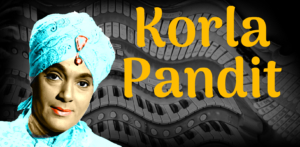
So much is made of the iconic look of Korla Pandit. Yes, it’s impossible to ignore.
Yet, when I think of him now – having known him personally and having been a fan for decades now, I never think of a turban or jewel when I’m thinking of him. It’s not relative to how I know him, how I respect his work. But for others, in fact the less you know Korla Pandit – that look is ALL you know. It’s the starting point, which is highly significant. The presentation.
This section will be a place to discuss image and persona, which are powerful elements of so many show-business careers. Many of our music icons have a defining “story” or more correctly, a reduced story – it’s something simple that can helps everyone notice and remember them. In music, it’s quite common. Here are some famous examples:
- Pete Townshend – smashes guitars
- Daft Punk – two robot/spacemen that are never seen
- Alice Cooper – evil, sadistic, twisted character
- Jimi Hendrix – set his guitar on fire and plays with his teeth
- Elton John – outrageous costumes and eyewear designs
- The Village People – gay stereotypes in costumes
- Keith Emerson – sticks knives into a Hammond organ
- KISS (original) – musicians in superhero-like costumes, never seen without makeup
- Ozzy Osbourne – bit the head off a bat, pissed on the Alamo, reality-show
- Iggy Pop – shirtless wild madman onstage
Yet actually, all of these are incredibly significant and substantial artists. They have world-class composition and music that is on a distinctly elevated professional level. But it’s their imagery that helped them get known, to cut past the thousands of others also trying to “make it.” Music is not enough, or – rarely is it enough.
Stage Names
Even with stage names: You dial the name UP to be notable, to stand out and to be easily memorable.
David Bowie, Lady Gaga, Bob Dylan, Joan Jett, Billy Idol. And in one very famous group, there’s Axl, Izzy, Duff, and Slash (but not Steve!); created to make something bigger-than-normal happen – – these are not their real names, but we don’t think of them as liars or pretending. Gene Simmons, Paul Stanley, Peter Criss, Ace Frehley – all four of them did it, and helped make them legends. In making up a stage name, they created a bigger-than-life persona – and stepped into it; they became that person.
And consider that we always see the real man sitting right there, no one hiding behind makeup or glasses like KISS or Alice Cooper or Elton. The same Korla face (charming eyes and smiling) is always there, the real man is connecting to you. He usually wore suit and tie; an incredibly common outfit for any man on television. But like Slash (who always wears his tophat onstage) Korla always appeared in his turban. Korla had a big Hollywood manager who told him “Never go out without the turban! It’s your image.” Like having a one-hit wonder; you cannot ignore it, it’s the key to your success, but also a burden as it becomes a focus, but a focus that is not the talent or the core person; it’s a costume.
However, in Korla Pandit’s case – there were also laws, pressures, and judgments. (Always keep in mind that he could have been black and still been famous – there was no law against that. Lena Horne, Count Basie, Nat King Cole, Billie Holiday, Miles Davis – they did it.) But the French/Indian persona allowed him attention and access not possible if he showed his true origin.
The Gotcha Moment
It seems today that so many people are focused on the “gotcha” moment (the revealing story by RJ Smith that publicly announced the real backstory and the stagemanship that was the Korla image). But in perspective, that may be the least-important moment of his career. Much more important was that he was a national recording artist, that he was a television pioneer, that he made dozens of incredible records, and established a style and presentation that was wholly his own.
Inherent in the fascination with this “gotcha moment” of his family’s history is a sub-current of racism and bigotry: If he WAS cool and fascinating when he was “French/Indian,” but he’s not when found to be black – it must seem that somehow the presence of an Indian musician is greater than being black musician? (So ironic, in that specifically the black musicians such as Hendrix, Miles Davis, Ellington, Bob Marley, Aretha – are essentially the peak of musical credibility?) Had the story been revealed that Korla was a man originally from Canada or Switzerland, would there be as much backlash against his persona and image?
We often think we know famous people – but it’s mainly surface-level knowledge: We don’t REALLY know the sides never-shown in public. You may not know how they are in quiet moments, their beliefs, their sense of pride or self-doubt. The same personal stuff that non-famous people also hide.
Those who knew him that intimately may have been the only ones who saw his inner parts. We’ll never know how proud Korla was of his musical and societal accomplishments. But maybe the Indian-musician tagline made him feel like an impostor sometimes? It’s possible that he was cool with it, accepting and proud of the distances he’d lept forward using that idea. Yet it’s truly sad that he could not be open and revealing to us during his lifetime, a time of greater openness and forgiveness than ever before. I can imagine that, and it feels rather healthy had he been able to let us know how he felt: That may have given him a chance to tell his side of things, what it was like to be him inside it all. And to finally be free of any concepts that felt deceptive. He could still be an icon, and wear the turban/costume when he was in public – it only makes sense that the look would still be appropriate for him. He WAS Korla Pandit. Every look and sound and effect he made was created from him for us, so the fascination and joy he brought – then and now – belongs to him.