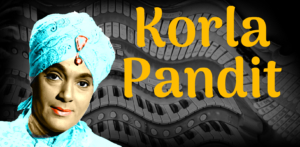
Childhood
The musical legend now known as Korla Pandit was born as John Redd on 16 September 1921 in St. Louis, Missouri.
One of six children, his parents were Baptist minister Reverend Ernest Redd, who was of African/American descent, and mother Doshia was of African/American and some English mixture.
John grew up as a child prodigy on the piano – in later years, he talks about having perfect pitch as a young child and being able to emulate bird and rain sounds on the piano – likely these stories are true. His family moved often, raising him in Hannibal, Columbia, Omaha, Ottumwa, and Des Moines. He was performing early on, at age 7 he was doing live radio work at KFRU in Columbia, MO.
Just out of high school, he is listed as an employee of CBS in Des Moines, Iowa. He had been offered the job as an organist for CBS radio, so he took 3 days inside a Chicago music store and learned to operate the Hammond organ, a move that would have immensely positive results for him – and for us! He says that, at first, he thought the Hammond was a poor instrument, incapable of the great sounds of the big theater organs, but he soon grew to love its unique tones. John was only about 17 at the time, but moving quickly upward with sich notable keyboard skills.
Family
His older sister Ruth Redd had moved to California, soon followed by another sister Frances. Around 1939, at the young age of 18, John Redd moved out West and stayed with sister Frances and her husband George Hernandez in Los Angeles. With two sisters there (and more family members to come) the Redd family had begun quite a presence in Southern California. Here, the dangerous Jim Crow laws were minimal or slowly losing effect. In essence, for a black family, California was not perfect, but far more forgiving and comfortable than most of the USA at that time.
His sister Frances had become an actress, starring in the 1939 film Midnight Shadow… with an all-black cast. It was advertised as “The colored screen’s first real murder mystery!” It may be notable that the male lead role played a black man who “passed” as an Indian; “Passing” is a common older term that meant he looked light enough to be – or to pass for – non-black. Notable, then, that in this story he was a man claimed to be from India, rather than black or caucasian. As part of his Indian guise, the character wore a turban with a jewel in front.
Early Music Life
Young “Johnny” Redd brought his musical skills with him, hoping to pursue a career as a professional musician. His first work/residence was in San Clemente, a comfortable beachside village between Los Angeles and San Diego.
He becomes a bandleader for his own 8-piece group, playing all styles. His base is the Garden of Allah in Long Beach, with many appearances at the Casino San Celemente, an incredibly trendy night spot that hosted touring big bands and celebrities from Hollywood. The place was working six nights a week, and especially crowded on the weekends. Palm Springs was becoming a hot spot (literally and figuratively) where he would appear at the South Seas Club. His “big band” era ended when quite a few of his musicians went into the military.
John soon moved up to Orange County, which is a bit closer to Los Angeles. He began commuting from there once a week to Hollywood to play the big Florentine Gardens room. His Hollywood gigs are where he met his new fans Bob Hope, Lana Turner, Abbot and Costello, Doris Day, and Tommy Dorsey. He said “I was lucky, I came in on the end of the big band era. Hollywood Blvd was the center of it all, and the Boulevard was clean…” He kept busy in whatever venue would have him. The Hollywood Jade Room featured him on solo piano, he played organ at the massive Orpheum Theater downtown, and also accompanied shows filmed at the RKO motion picture lot.
Being a Black Musician
At the time, being black could still be a rather challenging life even in progressive Southern California. Black musicians were still restricted to using service entrances (the back door) of clubs and restaurants. Black musicians were segregated into a lesser Musician’s Union that had restricted opportunities and lower pay. But since California was Hispanic territory – with Latin music of all kinds being popular – Hispanics were allowed in the desirable Musician’s Union Local 47. With his light-colored skin and straight hair, John Roland Redd could definitely “pass” for Mexican, so he became a professional “Latino” pianist, changing his first and middle names to Juan Rolando – and joined the Local 47 Union.
There were also local black clubs where he still appeared without changing his name or persona: Keeping in mind, for many Los Angeles venues in those days, a black musician would still have to enter only as a worker from the rear entrance – when whites or Hispanic players did not. From his promising beginnings, he began to get steady work, and his reputation as a master player was spreading fast around town.
